Normally this would be a big, wonky, in-depth analysis, but I'm gonna keep it relatively basic this year for two reasons: First, because the final numbers are only slightly different from what I had them at already (seriously, I was only off by around 5,300 enrollees out of over 11.4 million total); second, because with the COVID-19 pandemic having killed well over 5,000 Americans already with no end in sight, I'm not sure anyone really gives a crap at the moment.
Well, today I received a likely answer which is depressing but not surprising at all: According to my sources, there isn't any technical, logistical, personnel or support reasons why HealthCare.Gov couldn't launch a formal COVID-19 Special Enrollment Period at any time. The only logical conclusion is that the White House has decided not to allow one for political reasons.
...The more people who come to rely on the Affordable Care Act--especially the ACA exchange operated by the Trump Administration itself--the more difficult it's going to be to justify the Trump Administration continuing to support a lawsuit with the sole purpose of attempting to have the ACA struck down by the Supreme Court...which they're continuing to try and do even in the middle of a pandemic.
Over the next week or so, more and more of the 13 state-based ACA exchanges announced just such a COVID-19 SEP; eventually 12 out of 13 state-based exchanges did so (Idaho is the odd man out), and eventually even the health insurance industry (which is normally opposed to allowing exceptions to the official Open Enrollment Period) were onboard with a COVID SEP. Two weeks ago I was 95% certain that HC.gov would be announcing one at any moment.
And then...nothing. Nothing last week. Nothing yesterday. Nothing as of this writing.
No one has been shouting from the rooftops louder than I have for HHS Secretary Alex Azar or CMS Administrator Seema Verma to join nearly all of the state-based ACA exchanges in announcing an official Special Enrollment Period (SEP) in light of the ongoing Coronavirus pandemic, and I'm still urging them to do so as soon as possible. The federal ACA exchange, HealthCare.Gov, hosts ACA enrollment for 38 states representing around 75% of the national population, so this is a pretty big deal.
Having said that, it's important to keep in mind that even without a COVID-19-specific SEP, many people already qualify to enroll in ACA-compliant healthcare coverage anyway, whether they're currently uninsured or because they're about to be...or because their personal circumstances are about to change. And none of these have anything to do with the COVID-19 crisis, although it's certainly going to cause a whole lot more people to qualify for two of those changes:
One week ago, in light of the growing COVID-19 crisis, I noted that California, the District of Columbia and Maryland were each offering Special Enrollment Periods which had nothing whatsoever to do with the pandemic.
California's SEP is for uninsured residents who didn't know that the state had reinstated the individual mandate penalty and expanded financial subsidies to those earning 400-600% of the Federal Poverty Line; DC is offering one for those who didn't know they had also reinstated the mandate penalty; and Maryland passed a clever law last year which lets residents check a box when they file their state taxes if they're uninsured which tells the state to contact them to help them enroll.
I concluded that:
...as far as I know, there's nothing preventing other state-based exchanges from establishing Special Enrollment Periods for the coronavirus crisis if they want to.
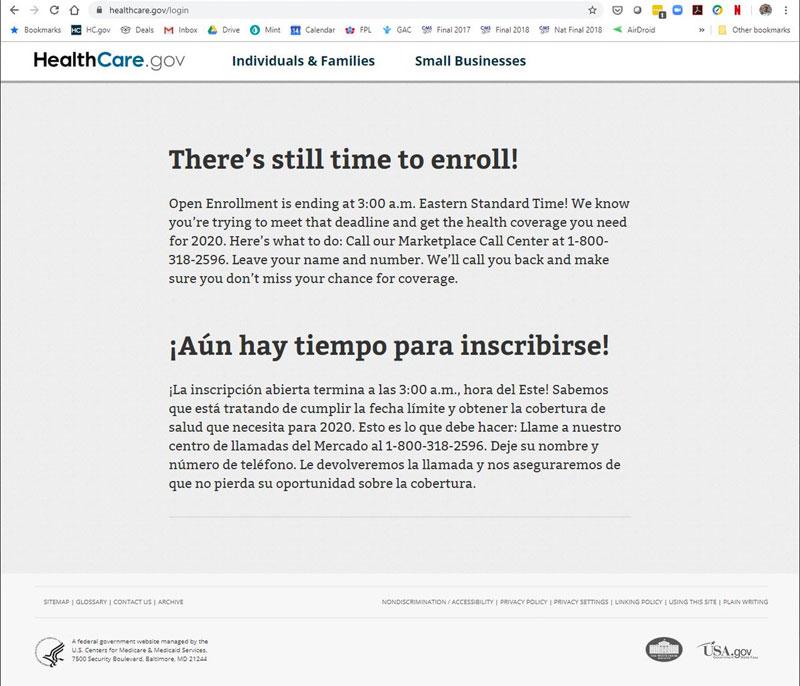
In response to tremendous pressure after yesterday's major technical issues at HealthCare.Gov, CMS Administrator Seema Verma just announced that the deadline for people to #GetCovered in the 38 states which host their ACA enrollment platform with HealthCare.Gov will indeed be extended by 2 days:
We at @CMSGov want to ensure a seamless shopping experience for everyone seeking coverage, so starting at 3 pm ET today, we are extending the marketplace #OpenEnrollment deadline until 3 am ET December 18! https://t.co/HmVdpJlX2C
Dammit, I took a couple of hours off to rewatch The Force Awakens with my kid (in anticipation of The Rise of Skywalker coming out this week), and look what happens...
HealthCare.Gov is not letting people login to enroll. This is the second outage, the first lasted 15 minutes. We're 8 minutes into the second. Last time this happened, 100k people could not enroll. @CMSGov must extend the deadline.
Critics say ‘junk plans’ are being pushed on ACA exchanges
The Trump administration has encouraged consumers to use private brokers, who often make more money if they sell the less robust plans.
The Trump administration is encouraging consumers on the Obamacare individual market to seek help from private brokers, who are permitted to sell short-term health plans that critics deride as “junk” because they don’t protect people with preexisting conditions, or cover costly services such as hospital care, in many cases.
A week or so ago I noted that several of the 13 state-based exchanges (remember, Nevada split off of HC.gov this year) had opened up their ACA exchange websites for prospective enrollees to window shop for 2020 coverage. One of them, Covered California, actually started allowing people to enroll already; the rest were for comparison shopping only.
Well, as of today, residents of every state can window shop for 2020 healthcare policies, because HealthCare.Gov has followed suit and is now letting you plug in your household & income info to see what plans are available next year, what the unsubsidized premiums are, and (most importantly for a lot of people) what sort of financial assistance you may be eligible for.
There have been some interesting modifications to the interface and workflow of HC.gov this year:
LAS VEGAS (KLAS) — In a statement issued by Nevada Health Link, the organization announced that it had become aware that the Federal Health Insurance Marketplace, known as HealthCare.gov had incorrectly sent notices to Nevada consumers regarding the upcoming open enrollment period.
The incorrect notices were sent to Nevada consumers via mail, email and through notices on the HealthCare.gov portal.
"These notices from the Marketplace were sent in error. Nevadans who received these notices from the Marketplace should be aware that NevadaHealthLink.com is the only place to get enrolled in a qualified health plan during the next open enrollment period beginning on November 1, 2019," said Heather Korbulic, Executive Director for the Silver State Health Insurance Exchange.
Nevada consumers are asked to reach out to the Nevada Health Link consumer assistance center for further questions by calling 1-800-547-2927.